


RLE (Refractive Lens Exchange) is a general name for a method, whereby a transparent lens (without any signs of cataract) is replaced by an artificial lens (monofocal or multifocal). This method is used in patients with any of the following: short-sightedness, long-sightedness, astigmatism or presbyopia.
In the past the name CLE (Clear Lens Extraction) was often used almost exclusively with a method of correction of a higher form of short-sightedness using monofocal implants.
PRELEX – Presbyopic Lens Exchange
The term PRELEX is used to describe a surgical method whereby we replace the natural lens with an artificial multifocal or EDOF (Extended Depth of Focus) lens.
The course of the surgery
The surgery takes place as part as an outpatient clinic and the operated eye is desensitised using eyedrops. At the same time medication dilating the pupil is administered, so that the lens positioned behind the colourful iris, becomes accessible for the surgical procedure. In patients that are very nervous or anxious it is possible to administer a calming pill. The procedure itself takes about 15 minutes. In some clinics, both eyes are operated at the same time. At our clinic, we opt to only operate one eye at a time for several reasons. The other eye is operated within 2 days from the first surgery.
We carry out this surgery under the strictest of guidelines concerning sterility and the face is covered using a sterile drape. The eyelids are kept apart using a special clasp that gently pulls them apart and prevents the eyes from blinking. The main surgical incision is done through the cornea. Depending on the type of implant, the incision is most commonly 2 to 2.5 mm wide and because of its self-sealing property there is no need for sutures.
The inner structures of the eye are protected using a special substance during the operation – a viscoelastic material. This is removed from the eye shortly before the surgery is completed. Once the central part of the front cover of the lens is removed, the natural lens is sucked out using a phacoemulsification device. The remaining part of the casing is cleansed thoroughly so that everything is prepared for the implantation of an artificial lens.
The artificial lens is rolled-up so as to easily pass through the tiny incision into the eye, where it unfolds into its original shape and size. Inside the eye, it is then placed into the original casing of the natural lens and is fixed into position. The surgery is completed once the final cleansing is done. At the end, in cases where it is needed, astigmatism is also checked and corrected.
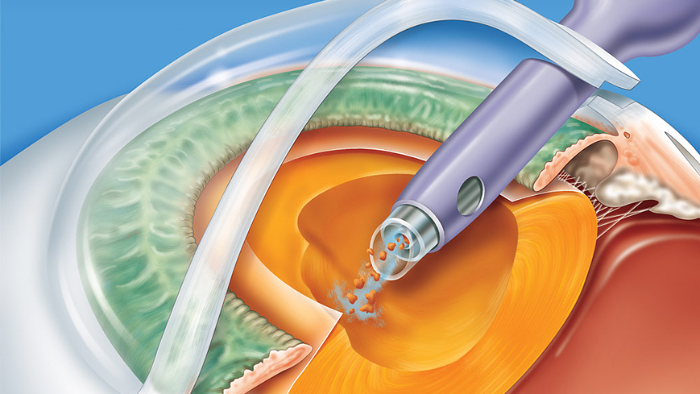
The tip of the phacoemulsification device removes pupil matter through suction
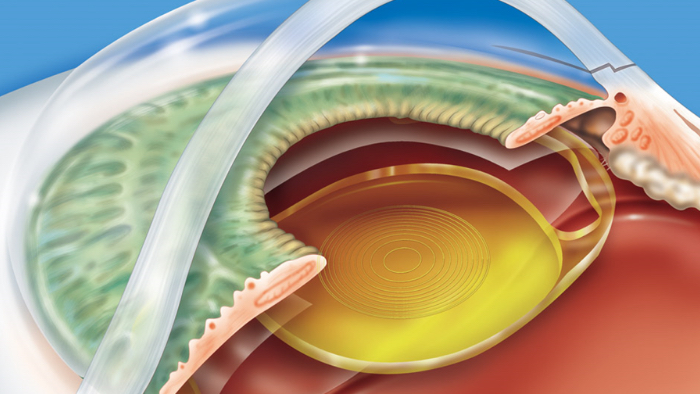
The multifocal lens is centered withing the casing of the original natural lens
Fill out the appointment form and we will get back to you with suggestions of an appointment.
Expected effect of the surgery
Most patients noticed a considerable improvement in seeing immediately after the surgery of the second eye. The image may be slightly shaky in the first few weeks. The patients sometimes feel over-exposure from bright light and notice a change in colour perception (more intense white and blue). Furthermore, unpleasant light phenomena may appear around lights at night (halo and glare).
The image is gradually stabilised, and the unpleasant side-effects subside. Some of these may, however, persisit in one form or another. This is why pre-surgery preparation is essential – especially the choice of correct implant depending on the individual needs of each patient.
The basic principle of human vision depends on the fact, that in reality we do not see with our eyes but with our brain. The eyes mediate reception of the image of the surrounding world but its final analysis is done in the brain. This is why, after this surgery, an individually long period known as neuro-adaptation follows.
This period may be short, a matter of weeks usually, but it may take up to several months. This may be so even in case that the surgery went smoothly and without any complications and the resulting dioptre result is perfect. We most often hear of a lengthy neuro-adaptation period in cases of monovision (where each eye is aimed at a different distance) and with multifocal implants.