

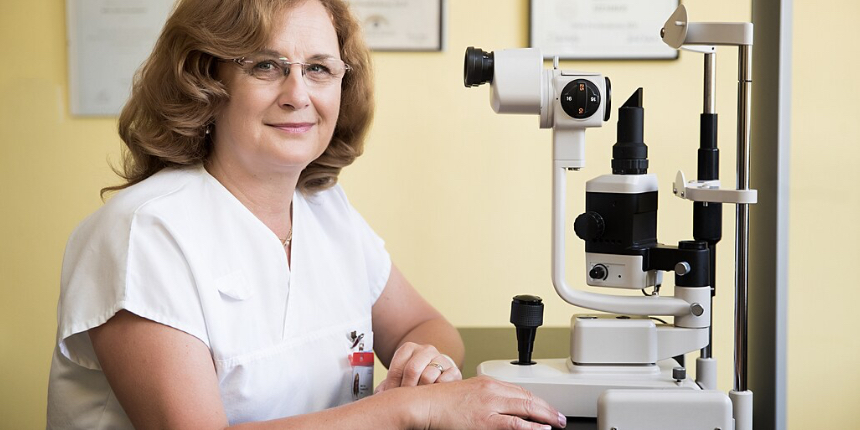
“In the past, having undergone a cataract surgery, the patient would have several sutures in the eye. Today we manage these surgeries without the need for sutures and the patient can see the very next day.” Says the ophthalmologist Dr Sylva Procházková.
Author
Tereza Blažková
editor MF DNES
Thirty years has passed since the ophthalmologist, Dr Sylva Procházková, performed her first surgical procedure. Back then she carried out the surgery using a graphene knife. Nowadays she uses laser. She remembers patients in whose case the entire lens was extracted, and the eye was left without it. “Today we can implant lenses that enable seeing on several different distances and on top of that filter UV rays as well as blue light” she lists as an example of the progress that has been made in her interview for MF DNES.
You`ve worked thirty years in the field and completed several thousand surgeries – has your outlook on Ophthalmology changed over that time-period?
Indeed. We have far better diagnostics now, better equipment, greater possibilities. I personally mostly specialise in cataract surgeries. Globally, this is the most frequently performed surgery on the human body. The progress in this area has been immense. This is, among other things, also because the World Health Organisation continues to invest in its research and development.
How has cataract treatment changed?
In the year in which I started doing eye surgeries, it was the end of the extra-capsular type of cataract surgeries. This was a method whereby an incision was made into the eye beneath the eyelid and the lens was squeezed out of its casing.
At the end of this era, the so-called phacoemulsification came into play and this is still done today. Here, the lens is crushed using an ultrasound probe inside the eye and is then sucked out.
Crushed and sucked?
Yes. As such the casing of the lens is kept intact and a new artificial lens can be placed within. The incision into the eye was done using a knife across half the eye when I was starting. Nowadays, all the is done are three tiny micro-surgical incisions 1 to 2 millimetres wide.
How then do you manage to insert an artificial lens inside?
It is rolled up. Once inside, it opens again under our supervision. When I used to assist my father during eye surgeries, who was an Ophthalmologist too, we used to close the wound using several sutures. The patient would then spend the following three weeks admitted in the hospital. We would extract the sutures three months post-surgery. The patient would not see sharply for three whole months. Today, the surgery takes barely ten minutes, the patient goes home right afterwards, has no sutures, and sees well the very next day.
Is there a chance of avoiding cataract or is it something that we all will eventually have to deal with?
Yes, it is something that will affect us all. We now live longer while the lens has evolved phylogenetically to last only a certain time-period. We frequently register changes in the lenses in patients who re a little over fifty years old.
Is the patient often unaware that he/she has a cataract?
Yes, he or she may have absolutely no idea. This is due to the plasticity of the human brain. The brain gets gradually accustomed to deteriorating vision and adapts. Most patients come to realise they require surgery once their glasses become less and less satisfactory and come in for a new prescription.
Is it possible to deal with other eye issues, for example dioptre error during a cataract surgery?
Precisely. This can be combined indeed. A multi-focal lens may be implanted instead of a clear one and thus we may resolve distance vision, close-up vision and well as the middle distance. It is also now a possibility to implant lenses with different filters in them, for example a blue light filter, which is known to be harmful.
It almost seems as though it may be better to have one`s eyes removed entirely for preventive reasons since the artificial lens is far superior?
I would not claim that. But the artificial lens may be technologically better equipped. The specialist must then assess whether the patient will be able to fully utilise its potential. It is true to say though that many patients in their eighties say that they have not seen this well even in their twenties. There is huge progress in the implants.
Laser eye surgeries are experiencing a boom in the recent years. These eliminate some types of dioptre error. What happens during this type of surgery? Is it a quick procedure too?
Yes. Nowadays, refractive surgery works with lasers to evaporate away a precise number of layers of the cornea cells depending on how many dioptres the patient needs removed. The surgery of both eyes takes about twenty minutes. The whole process is completed without having to admit the patient.
Who can undergo this type of surgery? Are there any counterindications?
If the patient suffers from systemic diseases, then we cannot recommend this surgery. Similarly, a twenty-year-old patient should not be operated unless his vision is stabilised. It is also important to not forget that laser eye surgery is not a treatment, it is an above-standard-service.
Cataract must be removed even if the patient suffers from other grave ailments. The patient sees poorly and there is a chance to improve his or her vison. Even if you should improve the quality of life for just a month, you`d still do it. That person may live by himself and needs to see.
Do you think that in recent years the structure of patients and their needs is changing? Perhaps due to their time spent Infront of computers? Does this affect vision?
I don`t think so. If this was so, then all people working in IT would experience issues. There are studies saying that people working with computers blink less and therefore they are more likely to suffer from the dry eye syndrome. This is currently a bit of a boom. In the past people were not even aware of this.
Is there something that ophthalmologist still have no ways of dealing with?
Hereditary diseases of the retina are an issue still, is the. Here, there is ample room for improvement. There is no one capable of performing a retinal transplant just yet. We have great faith in stem cell treatment in the future. We believe that this will address some ophthalmological diseases of the eyes caused genetically. Diseases that manifest themselves also in young patients. Some of these patients go blind, we know why but are unable to help them.
We have lived through more than a year in the Corona virus pandemic. One of the symptoms of the disease appears to be conjunctivitis. Have you come across this problem?
Yes. Since Nemocnice Na Homolce hospital was one of designated coronavirus hospitals, I also dealt with it with my colleagues form the Intensive Care Unit (ICU). Patients experiencing severe problems when admitted with coronavirus often had extreme problems with the conjunctiva.
Can this have any consequences?
Some patients experience a permanent feeling of irritation in the eyes and a swollen conjunctiva. They feel discomfort which we help them deal with using mucosal immunity and artificial tears eye drops.
Was the pandemic tangible in the way patients came in for check-ups and surgeries?
Yes, patients often postponed both, preventive eye check-ups as well as cataract surgeries. Now, I perform surgeries on patients whose GP recommended cataract surgery a year or longer ago. When the surgery is not performed dully it is much more difficult.