


What types of dioptre errors can be resolved through surgery?
Intraocular refractive surgery is meant for patients that suffer from one of the following refractive defects – short-sightedness, far-sightedness with or without simultaneous astigmatism and in patients with age-related presbyopia.
Implantation of phakic lens
This surgery method is meant primarily for correction of a greater degree of short or long-sightedness. It is an option in cases where laser eye surgery would have little or no effect or when it could be risky (high refractive error, thin cornea). Nowadays, it is also possible, in some cases, to use multifocal phakic lens implantation in order to resolve the problem of presbyopia.
RLE, PRELEX – refractive lens exchange
This is the optimal method to use in patients with either short-sightedness or far-sightedness with presbyopia (usually patients aged 40–45 years and above), where a laser eye surgery would only eliminate a part of the problem causing deteriorating vision.
The implanted intraocular lens may be monofocal (this resolves only either short-sightedness or long-sightedness), monofocal toric (this resolves simultaneously either short-sightedness with astigmatism or long-sightedness with astigmatism), multifocal (this resolves short-sightedness and long-sightedness simultaneously as well as presbyopia) or multifocal toric (this resolves a combination of short-sightedness or long-sightedness in combination with presbyopia and astigmatism.
Intraocular refractive procedures that resolve astigmatism at the same time
- Primary procedures – we resolve astigmatism during the actual refractive procedure
- Secondary procedures – we eliminate any residual astigmatism at a later time
Primary procedures
- Astigmatic Keratotomy (Arcuate Keratotomy AK or Limbal Relaxing Incision LRI)
- Femtosecond Laser Assisted Arcuate Keratotomy (FLAK)
These are most frequently used techniques, whereby we can eliminate astigmatism directly from the cornea during the actual refractive procedure itself. It is ideal for resolving astigmatism in the range of ±1.5 dioptres.
- Implantation of intraocular toric lens
In cases that the astigmatism exceeds the ±1.5 dioptre range, the solution, decidedly, is the implantation of a toric implant. Toric implants exist in the mono as well as the multifocal version (this also applies to phakic implants).
Before the surgical procedure itself, we carry out measurements that enable the surgeons to select the optimal dioptre strength and to ascertain the required orientation of the implant within the eye so as to correct the astigmatism effectively. Toric IOL have special marks in the peripheral part of the lens that enable the surgeon to know where the exact axis needed to correct the astigmatism lies. Once the toric lens is implanted into the eye, the surgeon rotates it into the correct position (he marks this on the eye prior to the surgery). This leads to the correction of astigmatism and thus high-quality vision is reached.
Using toric intraocular lens does not increase the risk of common complications. Only the wrong primary position of the toric IOL or its rotation in the post-surgery period may cause blurred vision that is not easy to correct using glasses or contact lenses. In such a case it is necessary to re-operate and move the lens into the correct axis.
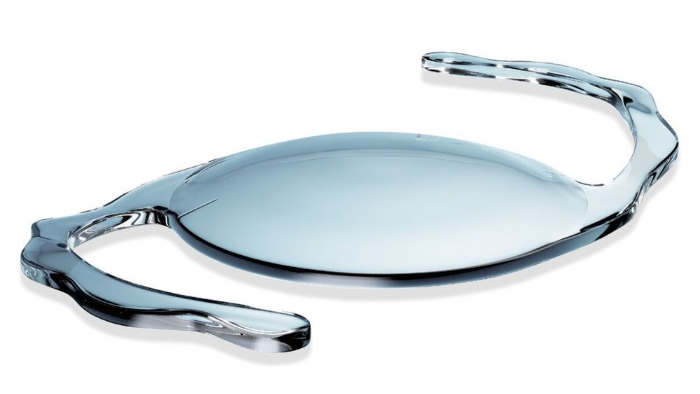
Toric lens for the final correction of astigmatism Sulcoflex
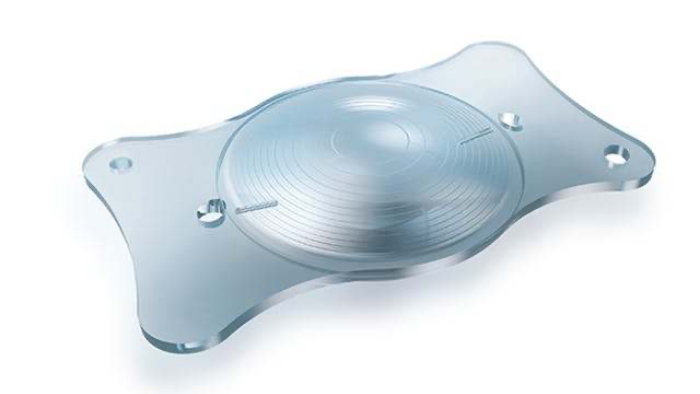
Toric multifocal lens At Lisa
Secondary procedures
In this case the final correction of astigmatism takes place at a later stage. The final correction may be planned upfront (two-phase procedure – bioptix) or can be used to eliminate astigmatism that appeared later, possibly as a result of a different disease (keratoconus).
- Excimer laser final correction (LASIK, PRK)
This is normally carried out some 3–4 months after the primary procedure. The greatest advantage of this is the precision of the correction of the residual astigmatism, the possibility to make the procedure completely tailor made (in case of irregular astigmatism for example) and last but not least the option to resolve the residual refractive error as a whole (residual short as well as long-sightedness). We usually use this method as a primary planned two-phase procedure in patients where we implant multi-focal or EDOF implant and wish to forego the risk of even the slightest rotation accompanies with imperfect vision.
- Implantation of the so-called “Add On” lens
These are lenses that are implanted into the eyes after cataract surgery or PRELEX, more specifically into the space between the iris and in front of the original implant (into the so-called sulcus ciliaris). These are similar to traditional toric implants but are larger in size and also have a modified shape (feet) that ensures better fixation while at the same time minimising the risk of rotation.
This method is a solution to astigmatism and of possible residual refractive error (short-sightedness or long-sightedness). It is used as a secondary option of ensuring multi-focality in cases where a mono-focal lens was implanted as part of the primary procedure.