


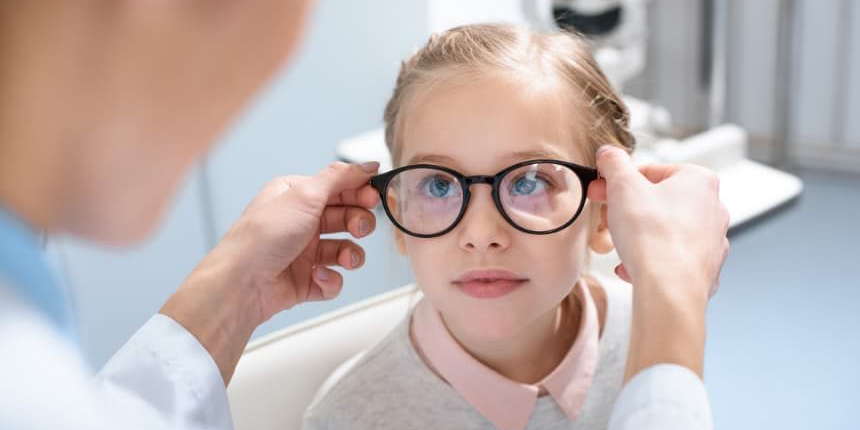
Does your child have attention span issues? Is your child often suffering from headaches? Is your child often rubbing his/her eyes? These are but a few symptoms that may alert parents to the fact there may be something the matter with their offspring’s eyes sight. Genetical as well as acquired eye diseases, when unrecognised and thus untreated, congenital as well as acquired vision ailments may cause worsening of vision with age and may be irreversible in adulthood.
Consultant in Charge, Dr Petr Novák, our foremost eye specialist, says that it may be surprising to some that children too may suffer from eye diseases often associated with advanced age (cataract, glaucoma). In congenital cataract this is often the case of the lens being affected from one or both sides. The cause may be anything from an illness where high fevers were present, infection of the mother in the first trimester, family predisposition as well as unknown factors. It manifests itself in clouding of the lens in the optical axis of the eye and it is usually discovered during the post-natal examination that every new-born child undergoes (healthcare in that sense is of extremely high quality in the Czech Republic in comparison with the rest of the world). The course of treatment is decided depending on the degree of clouding and whether it is one or both sided. When the clouding is one sided – surgery is permitted immediately within the first few months from birth. In cases of both sided clouding or when the extent of the clouding is lesser it is possible to postpone surgery.
Children may also suffer from glaucoma as a result of family predisposition or specific structural or anatomical changes in the eye that lead to the accumulation of fluids in the eyeball. This leads to increasing of the intra-ocular pressure passed to intra-ocular structures subsequently leading to pressing on to nerve fibres in the optical nerve on the rear pole of the eye. The resulting complication could have permanent consequences and as such it is essential that it is recognised early. The solution is immediate medical or surgical treatment.
The most apparent as well as most common vision problem in children is refractive dioptre error that may present itself at a very early age. It usually becomes apparent during play, in the child’s perception of distance, bumping into objects, inability to tell apart shapes, toys, picking items up etc. Usually the parents become aware of something being out of order and when that happens, they should alert their paediatrician immediately. Problems are also frequently discovered during routine check-ups. What should follow is an examination at a designated child eye specialist who should either confirm or rule out a problem and who, in case of problems, recommends correction through glasses or otherwise. There are three recognised refractive issues – near-sightedness (the error is corrected using glass or lenses with minus values), far-sightedness (the error is corrected using glass or lenses with plus values) and astigmatism (the error is corrected using glass or lenses with cylinders). Untreated issues, especially in cases where problems are only on one side can lead to the so-called lazy eye (amblyopia).
Lazy eye (amblyopia) is a functional defect of eyesight sharpness that occurs in childhood usually as a result of strabismus (crossed eyes), a high refractive error, anisometropia (meaning a higher dioptre difference between the two eyes) or other eye diseases (for example congenital cataract etc.). The eye sight functions of children develop up to six to eight years of age and any obstacle in the normal functioning of the eye in early childhood may permanently weaken the eyes. In practice, this means that a lazy eye, even with the best possible corrective aids (glasses or contact lenses) cannot attain sharpness of eye sight such as in a healthy eye. This limits the effect of refractive surgery as well. Refractive surgery may eliminate dioptre error however it will not eliminate amblyopia.
Strabismus (crossed eyes) is a defect in the parallel positioning of the eyes. It arises usually as a result of congenital or acquired defect of eyesight or the functions of the eye muscles. The deflection of the eye may be one or both sided depending on the degree of vision impairment. Each patient with this problem must undergo specialised strabological examination. This is because there exists a certain connection between the positioning of the eyes and dioptre errors. In some cases, the removal of the error may result in the elimination of the strabismus as well while in other cases the elimination of a dioptre error could lead to significant worsening in strabismus or even the onset of the very unpleasant double vision (the so-called diplopy).