


Pterygium is one of the degenerative diseases affecting the conjunctiva. A healthy conjunctiva is a smooth and transparent tissue that covers the surface of the eye and the inside of the eyelids. The main symptom of pterygium is the overgrowing of the conjunctiva tissue over the edge of the cornea. Throughout life, thee growth may increase and gradually stop growing. Pterygium may appear in just one eye or in both, it has an inclination to relapse and it affects men more often than women.
Pterygium may not cause any issues. Larger forms, such interfering with the centre of the cornea reduce the corneal sharpness. Sensations similar to pulling or increased pressure in the eye and unpleasant symptoms such as long-term irritation, redness of the eye or a feeling as if there was a foreign body in the eye may appear. It may affect anyone who spends considerable time outdoors. The main cause is a long-term exposure of the conjunctiva to ultra-violet radiation as well as dry eyes and irritating elements such as dust and wind. An American equivalent is the term “surfer’s eye” named after the most commonly affected group of people.
Treatment
Surgical treatment is unnecessary in mild cases, however, observation by a specialist is always recommended. A specialist may, should the situation worsen, prescribe a lubricating ointment or corticoids that resolve the redness, itching, swelling and pain in the eye. Sometimes, eyedrops with Mitomycin (a substance preventing further growth) are recommended.
Should the pterygium cause discomfort or affect vision, a surgical excision (extraction) is recommended. This is carried out under local anaesthesia and lasts up to 30 minutes. In cases that relapse, a short-term application of Mitomycin is necessary to complete the surgery. As in any other surgical procedure, some complications may arise. The most common one is inducing an even more aggressive growth, astigmatism or scarring of the cornea. This is why it is very important to consider all the pros and cons prior to undergoing this surgery.

Pterygium – the tissue of the conjunctiva overgrowing over the edge of the cornea
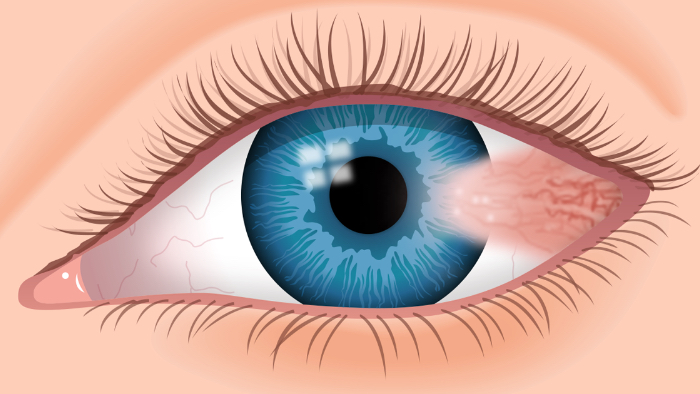
Usually it does not cause any issues but more extensive forms may reduce vision sharpness and bring on a sensation of pressure or pulling
Fill out the appointment form and we will get back to you with suggestions of an appointment.
Operating technique
The above-mentioned technique is suitable for an uncomplicated form of pterygium. The procedure is carried out under local anaesthesia, by applying eyedrops and a small amount of anaesthetic solution under the conjunctiva. Firstly, the head of the pterygium is loosened from the corneal tissue. Next, the surgical excision of the body of the pterygium follows, whereby all the tissue of the conjunctiva containing blood vessels and scarring tissue is removed. The procedure is completed by covering the entire exposed surface using lobe of the conjunctiva that is attached using individual sutures.
Pterygium has an inclination to relapse. The relapses as opposed to the primary appearance of the pterygium are characterised by a more aggressive tissue growth and this holds a greater risk of scarring of the conjunctiva and of the cornea as well. The risk of a relapse increases with every additional re-operation and what more, there is less conjunctiva tissue left each time needed to work with and to cover up the defect thus increasing the risk of infection.
After the surgery, antibiotics and steroids in the form of drops are prescribed for the duration of 2 to 3 weeks. Another 8 weeks of applying steroids locally then follows.
Pterygium and prevention
It is possible, to a certain extent, to forego pterygium. Use good quality sunglasses blocking 99–100% ultra-violet radiation A (UVA) and B (UVB). Remember that clouds (by the sea or high up in the mountains) do not block out radiation. Sufficiently large and well-fitting sunglasses offer not only UV protection but also prevent dust and wind from entering the eyes. Wear your good quality sunglasses also in the car. Specialists further recommend wearing wide-brimmed hats or a cap with a visor to protect your eyes from UV radiation. Use artificial tears (or eye drops with a protective UV filter) to keep your eyes moist in dry climate.